Engineering Maintainable ML & AI Systems
Moving beyond prototypes: architectural strategies and phased deployments for reliable, maintainable ML and agentic systems in production.
Architecting Maintainable ML and Agentic Systems in Production
Building modern intelligent applications—whether pure ML pipelines or agentic workflows—is fundamentally an exercise in system design. While it is entirely possible to push a bare model or standalone workflow directly into production, doing so without surrounding infrastructure means simply hoping that real-world conditions won't cause silent failures. Delivering a maintainable enterprise capability requires treating the core logic as just one component inside a broader software architecture that actively manages system boundaries, state, and operational risk.
Executive summary
- System over Model: Production AI requires a surrounding software architecture to manage state, data validation, and operational risk—not just standalone model code.
- Beyond Accuracy: Long-term ROI depends on balancing compute cost, latency, security, and compliance alongside model performance.
- De-risking Deployment: A 3-phase rollout with modular design prevents delivery stalls and adapts as underlying technologies evolve.
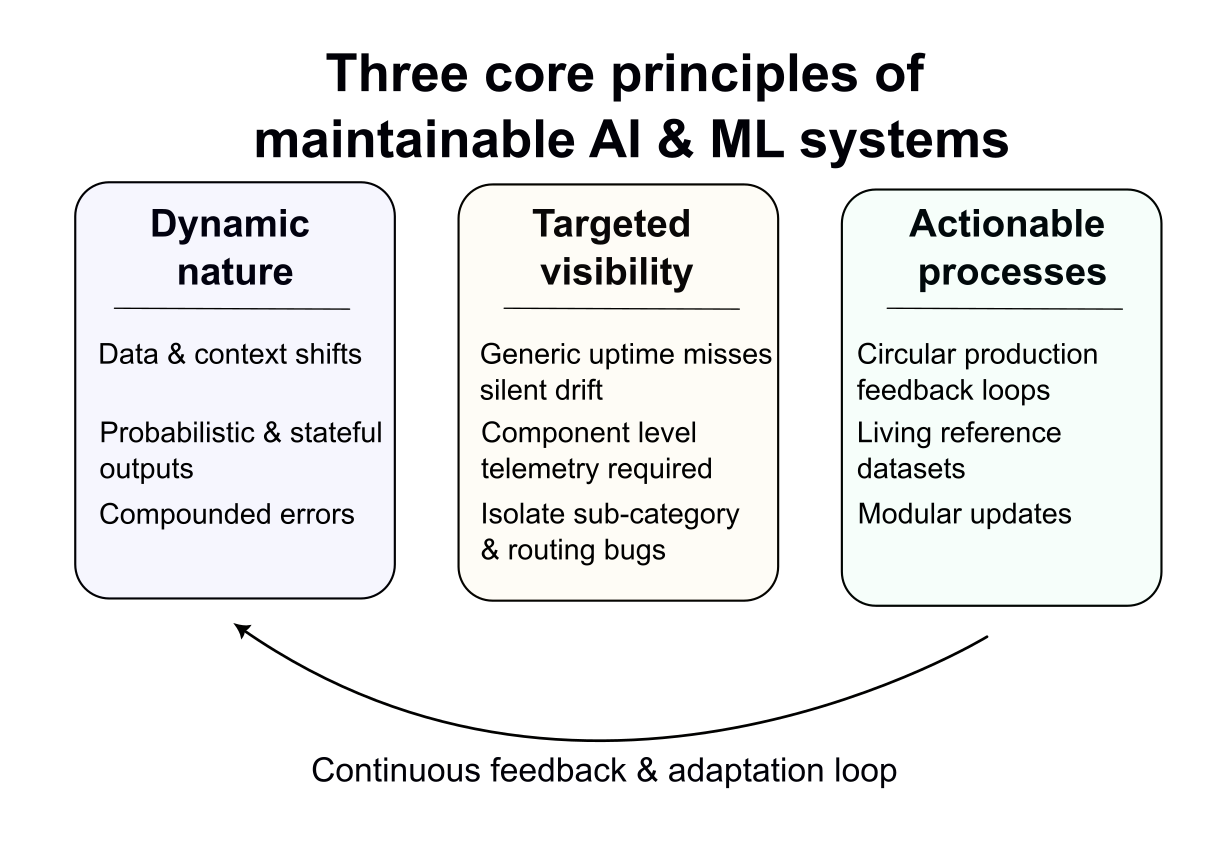 Figure 1: The three core principles of maintainable AI engineering: acknowledging dynamic systems,
establishing targeted visibility, and building actionable processes.
The Nature of ML & Agentic Systems (Indirect Logic & Operational Risk)
Traditional software development relies on explicit, deterministic logic where engineers write human-coded rules to transform inputs into outputs (Inputs ⇒ Explicit Rules ⇒ Outputs). When bugs occur in traditional systems, they produce identifiable stack traces or rule violations that can be isolated and fixed directly.
Intelligent applications introduce an indirect development paradigm (Inputs ⇒ Outputs ⇒ Learned or Emergent Rules). In pure ML systems, rules are inferred indirectly from historical data. In agentic workflows—whether orchestrated by language models, heuristic routing, or tool execution—non-linear execution paths create complex, emergent system behaviors. Because these systems are inherently dynamic rather than static, executing a functional script in a test environment merely proves baseline feasibility; it tells you very little about how the system will handle real-world conditions.
Furthermore, outputs across both ML and agentic workflows are frequently probabilistic and stateful. In multi-step architectures—such as recursive forecasting, multi-agent networks, chained model calls, or tool execution chains—minor inaccuracies at early stages compound recursively across downstream steps, leading to significant system-level failures. Static benchmark scores only measure performance against initial assumptions; once real-world data shifts out-of-domain, unmonitored performance can degrade rapidly.
System Architecture & The Operational Trade-Off Matrix
In a production environment, the core model or agent execution block is merely one component inside a much larger software ecosystem. Surrounding that central logic is the operational architecture that keeps it running: data validation, state and memory management, serving infrastructure, security controls, and telemetry. While constructing the baseline model or workflow can happen quickly, the real long-term engineering effort goes into sustaining this surrounding system over time.
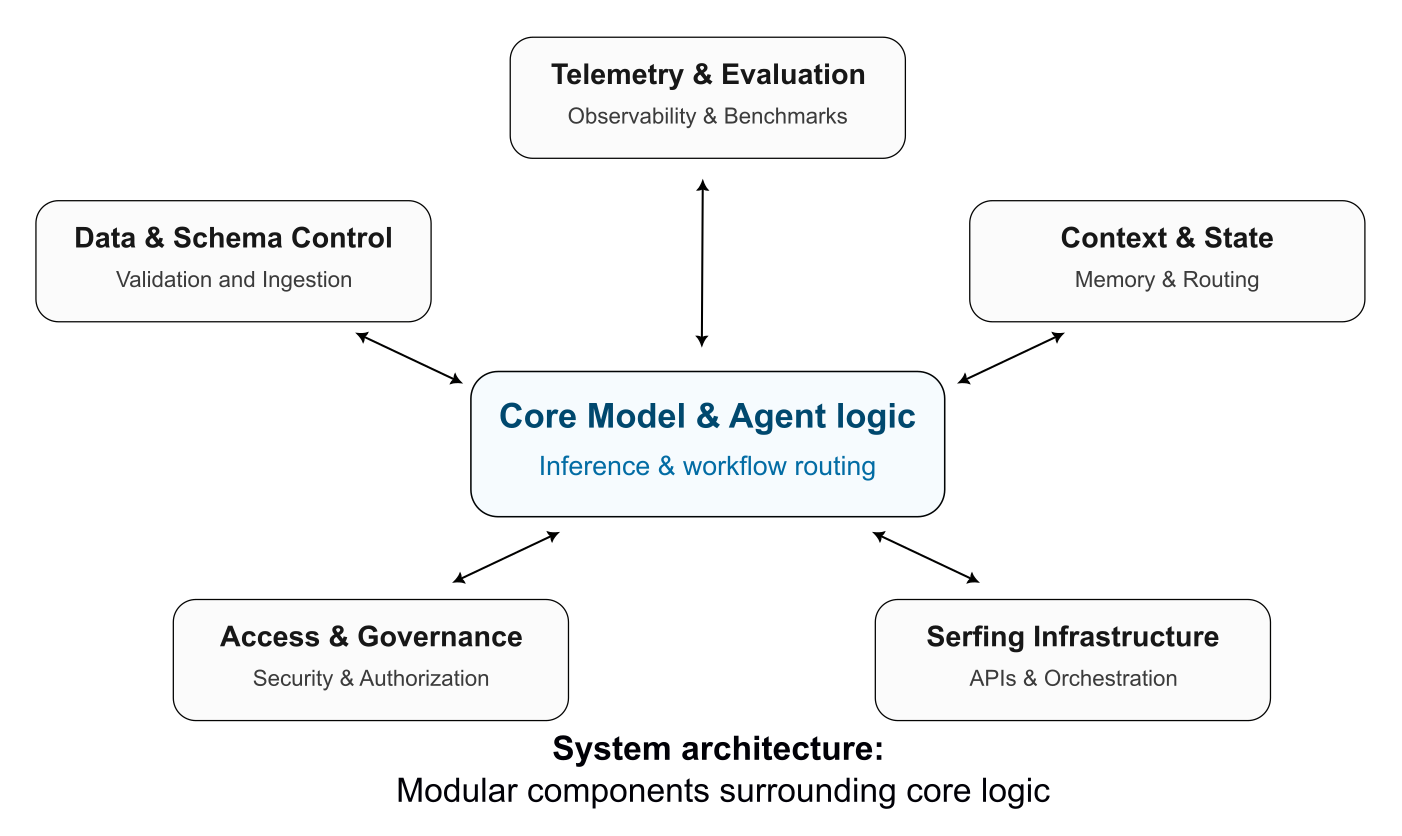 Figure 2: Enterprise AI System Architecture — Core Model & Agent Logic surrounded by essential operational infrastructure modules.
Designing intelligent applications requires balancing a multidimensional trade-off matrix. Rather than optimizing solely for model accuracy, engineers must navigate competing operational constraints—such as execution latency, compute cost, fault tolerance, maintainability, and security. Depending on the domain, other dimensions like data privacy, regulatory compliance, or explainability may take center stage. Crucially, maximizing performance along one axis inevitably requires deliberate compromises along others.
Navigating these trade-offs requires visibility into silent failures, where generic infrastructure uptime is insufficient. Because intelligent systems can remain "up" while their outputs quietly degrade, effective observability requires component-level telemetry tailored to specific failure modes—such as tracking sub-category performance in computer vision pipelines, measuring query intent drift in text-to-SQL tools, or tracing message flows across multi-agent networks. Maintaining and expanding a curated reference dataset of historical edge cases enables automated regression testing during ongoing maintenance.
A Phased Implementation Strategy
To reduce technical risk and avoid delivery stalls, system deployment should follow a structured, phased approach:
- Phase 1: Operational Foundation & Early Deployment: Establish core deployment pipelines (CI/CD), access management, configuration, and baseline monitoring upfront. Deploying a working baseline into a staging or parallel execution environment allows teams to gather authentic operational feedback early and validate system connectivity.
- Phase 2: Controlled System Experimentation: Systematically evaluate structural choices against defined operational metrics and your curated reference benchmark. For agentic workflows, this means testing rule-based vs. LLM routing, tool execution strategies, memory retention, and guardrail policies. For pure ML pipelines, it involves evaluating batch vs. real-time serving, model compression/quantization, and fallback rules for low-confidence outputs.
- Phase 3: Productization & Governance: Standardize data management pipelines, authorization protocols, automated alerting, and Standard Operating Procedures (SOPs) to ensure long-term operational stability.
Sustainable Maintenance & Modular Design
Building maintainable AI and ML systems often benefits from shifting away from one-off project deployments toward a more iterative development approach. Establishing a feedback loop where production data informs evaluation and error analysis can significantly streamline ongoing system maintenance.
Because underlying algorithms, framework libraries, LLM APIs, and infrastructure components mature at different rates, maintaining strict architectural boundaries is critical. Modular design ensures that individual components—such as a specific computer vision classifier, a vector retrieval module, an anomaly detector, or an agent routing module—can be upgraded or replaced as technology evolves without breaking adjacent system logic. Automating evaluation procedures and error tracking reduces response time when production anomalies occur, transforming a fragile workflow into a stable, maintainable organizational capability.

Kostas Tsolis
Director - Founder
ML engineer and founder of Dialectos.AI. Specializes in turning complex data signals into actionable business intelligence.