Model Selection for Time-Series Forecasting
Matching Your Forecasting Strategy to Your Data Maturity
Model Selection for Time-Series Forecasting
Successfully deploying a forecasting system is less about chasing the latest algorithm and more about architecting a solution to a specific business problem. Whether you are optimizing a supply chain, predicting peak energy loads, monitoring IoT sensor data for predictive maintenance, or managing retail demand, the model is simply a component in a larger decision-making framework.
To succeed, practitioners should embrace an Agile development mindset, prioritizing working software that delivers value early and iterates as more information becomes available. In forecasting, the "ideal" model is not a static choice; it depends heavily on your current operational reality and data maturity.
The Agile Choice: Navigating the Model Landscape
In an Agile environment, you shouldn't wait for a "perfect" dataset to begin. Instead, your choice of model should be driven by current data availability and specific business constraints.
These options are not necessarily sequential; your strategy should adapt as you collect more information or use techniques like data synthesis.
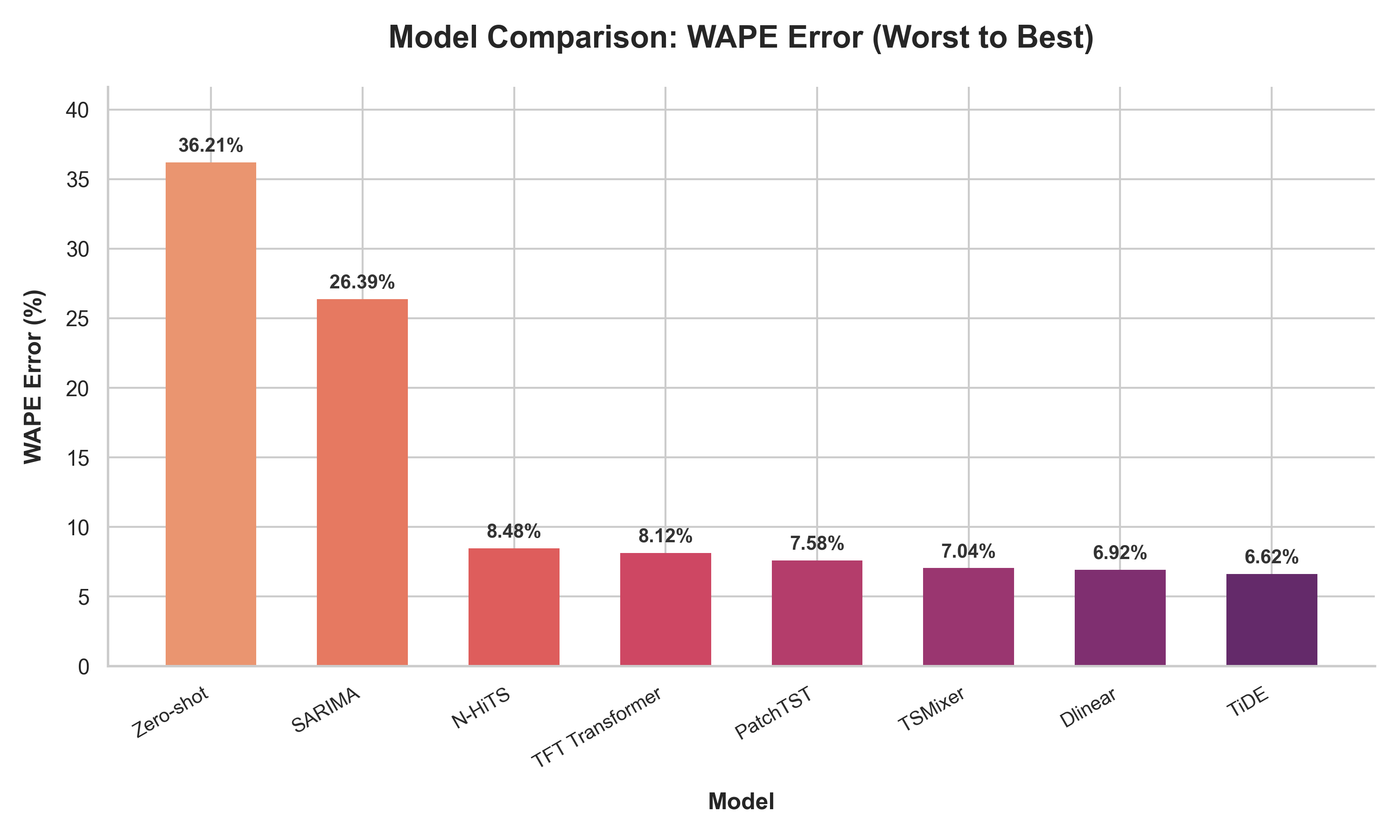
If you have zero historical data (real or synthetic) on Day 0, Zero-shot models like Chronos, TimesFM, or others allow you to generate predictions immediately. You get instant "working software", without any training effort, and establish an immediate baseline for future iterations. On the other hand, they might have the highest error rate at (36.21% WAPE in our benchmark).
Classical Statistical Models like ARIMA, SARIMA, or ETS are powerful when you have some data but perhaps not enough for deep learning. They are mathematically rigorous, lightweight, and very effective on small datasets where complex models might overfit. Their inherent interpretability remains a gold standard for stable processes. However, they require manual tuning, feature engineering and they are often limited to capturing a single pattern of inputs (e.g., linear trends or fixed seasonality)
Modern Neural Network architectures can model complex, high-dimensional datasets. Architectures like TiDE, Dlinear, or the TFT Transformer are the modern standard. You can even jump to this stage early by synthesizing additional data to train a model like Dlinear. They show exceptional flexibility and accuracy. Our tests show these models driving error rates down significantly, ranging from 8.48% (N-HITS) to 6.62% (TiDE). They natively handle non-linear relationships and "future-known" variables. On the other side, they have high data requirements, have higher computational costs, and potential "black-box" behavior that may require external explainability tools.
There is no golden solution. The right choice depends on the balance between your need for speed, accuracy, and interpretability at a given moment.
Data Properties and Quality: The Foundation of Performance
Model performance is inextricably linked to the nature of your data. An Agile approach allows you to adjust your model selection as you discover the inherent properties of your data stream:
- Input Dimensionality and Modality: Whether you are dealing with univariate, multivariate, or multimodal inputs (e.g., combining sensor data with maintenance logs).
- Leveraging Known Future Inputs: A major advantage in business forecasting is the ability to use exogenous variables known in advance (holidays, marketing campaigns). Architectures like the TFT Transformer (8.12% WAPE) and TiDE (6.62% WAPE) are designed to ingest these inputs to drive down error.
- Data Integrity: Your model must account for real-world issues like missing values or artifacts (invalid spikes) that can mislead simpler architectures.
Beyond Accuracy: A Multi-Dimensional Evaluation
A robust selection process requires evaluating "working software" across multiple dimensions:
-
Accuracy (WAPE): Our internal benchmarks show a clear progression in error reduction across model types, with TiDE (6.62%) and Dlinear (6.92%) currently leading the pack.
-
Bias and Reliability: It is crucial to measure if a model systematically over-predicts or under-predicts. A model with slightly higher error but zero bias is often more valuable for inventory management than a more "accurate" one that consistently causes waste.
-
Training and Inference Speed: Models like PatchTST (7.58% WAPE) or the TFT Transformer may require longer training times. For applications requiring real-time sub-second inference, lightweight models like Dlinear or TiDE are more practical.
-
Explainability: Trust is essential for stakeholders. Direct variable importance models (like Dlinear or TFT) offer transparency into how inputs drive the forecast, whereas "indirect" models like TiDE may require secondary tools (like SHAP) to explain their reasoning.
Process Over Perfection
The ultimate goal is not to find one "optimal" model, but to establish a process to measure and iterate.
Because data landscapes and business needs are constantly evolving, you need a modular framework that allows you to measure performance continuously across all these dimensions and swap components as better data or newer architectures become available. By prioritizing working software and an Agile mindset, you ensure that your forecasting solution remains robust and valuable from Day 0 through to advanced maturity.

Kostas Tsolis
Director - Founder
ML engineer and founder of Dialectos.AI. Specializes in turning complex data signals into actionable business intelligence.